
Impact Research Poll
Findings are based on two mixed phone and text-to-web surveys.
The Ohio statewide survey was conducted September 30 –
October 3, 2026, among N600 likely 2026 general election voters.
The Texas statewide survey was conducted September 30 –
October 5, 2026, among N801 likely 2026 general election voters.
Interviews were conducted in both English and Spanish.
The
margin of error for the full sample in OH is +/- 4.0% and in TX is +/- 3.5%; the margin of error for subgroups varies and is higher.
New data in Ohio and Texas show both states, which Donald Trump carried by double digits in the 2024 election, hosting incredibly competitive 2026 races. In each state, the Senate and Governor’s races are well within the margin of error. And the issue of health care – specifically protecting Medicaid and rural hospital funding – is a top concern for voters, helping Democrats have a path to a Senate majority, and will play an integral role in which candidates win these hyper-competitive races.
Ohio U.S. Senate and Gubernatorial Races
Despite a sample composed of +8 Trump voters (54% Trump / 46% Harris) and a +11 GOP party-ID advantage (37% GOP / 26% Dem / 32% Ind), Democrats hold a narrow lead in both the Senate and Governor’s races.
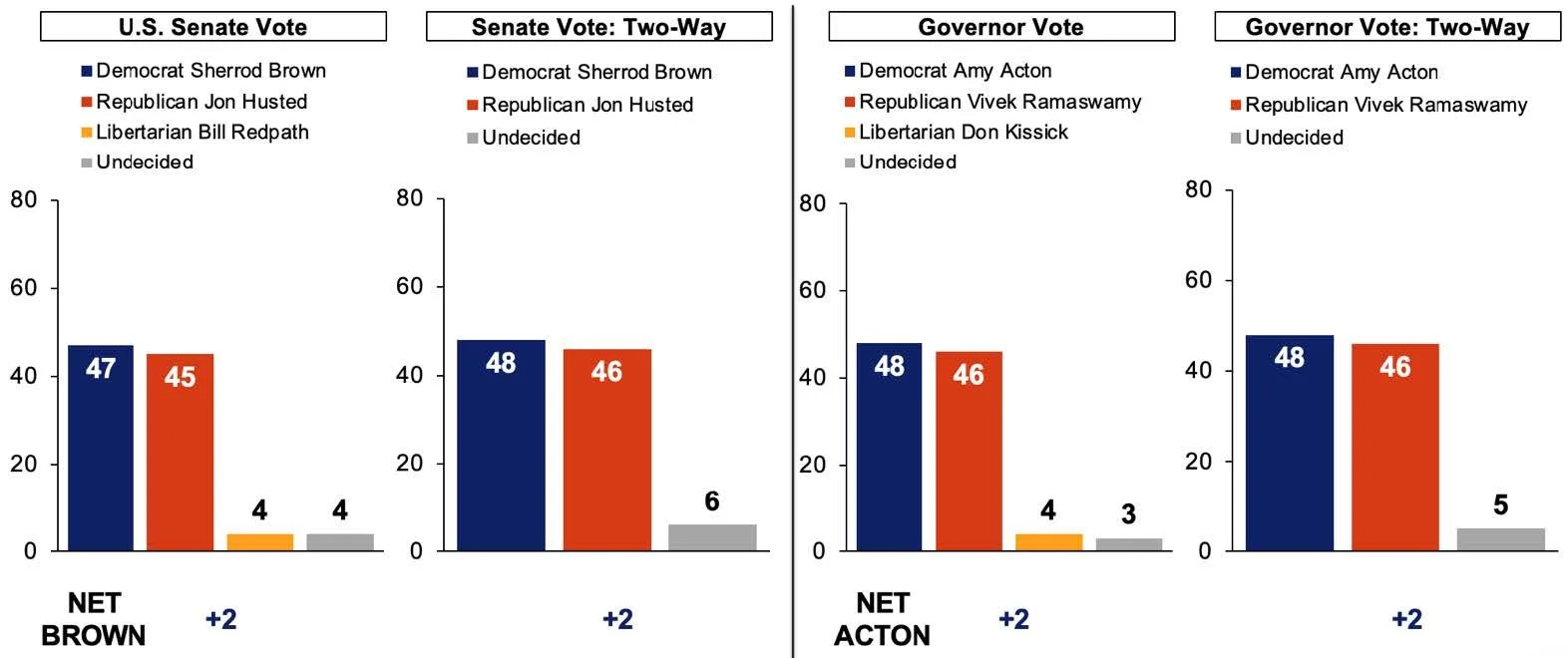
The Democratic candidates’ advantage in both races is driven by sizable margins among self-identified Independent voters. In the full Senate ballot test, Sherrod Brown leads among self-ID Independents by 21 points (54% Brown / 33% Husted) and Amy Acton leads by a similar 18-point margin in the Governor’s race (53% Acton / 35% Ramaswamy).
Texas U.S. Senate and Gubernatorial Races
In a sample composed of +12 Trump voters (56% Trump / 44% Harris) and a +11 GOP party-ID advantage (39% GOP / 28% Dem / 28% Ind), James Talarico leads the Senate race by two points and Greg Abbott leads the Governor’s race by a single point.
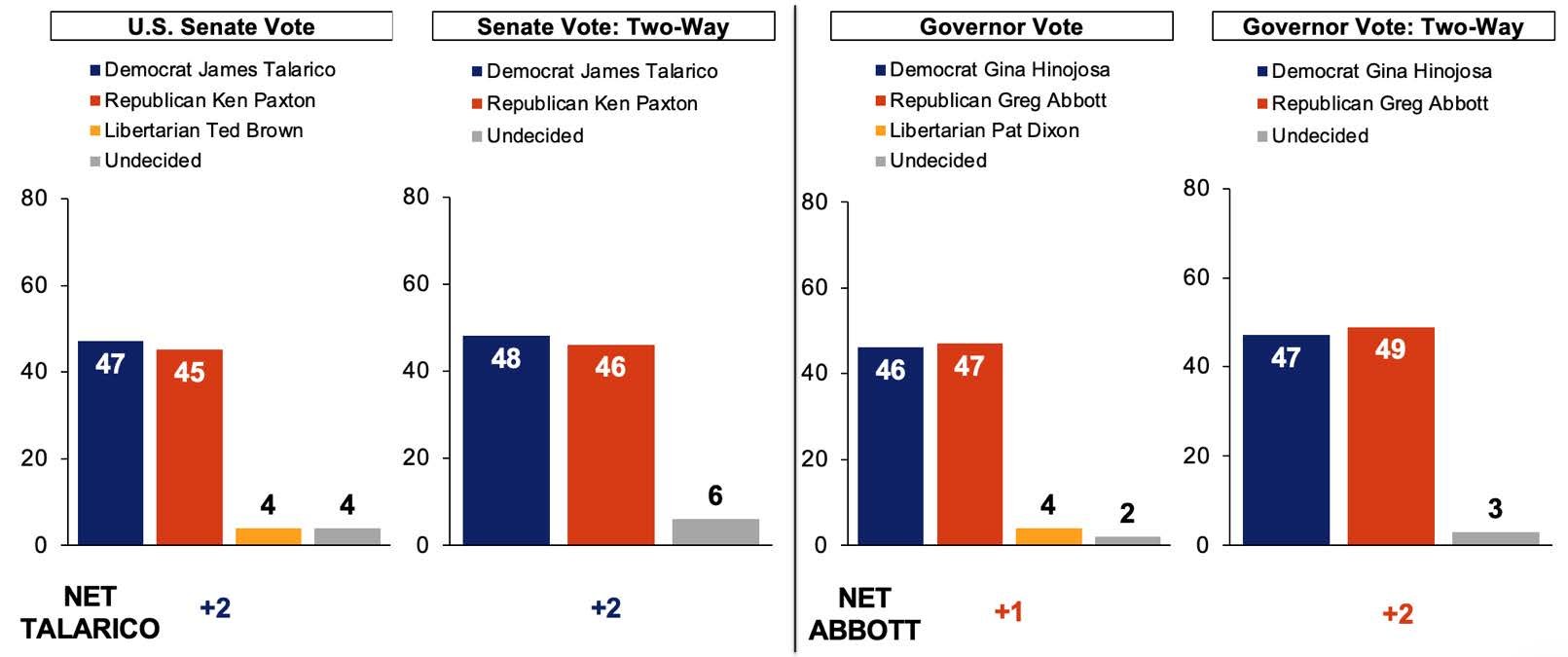
Democrats are putting these races in play in a traditionally Red state through double-digit margins among Hispanic voters and Independent voters. In the Senate race, Talarico leads among Hispanic voters by 21 points (56% to 35%) and by a +32 margin among self-ID Independents (57% to 25%). Those margins are slightly narrower among Hispanic voters and 10 points narrower among Independents in the Governor’s race, with Gina Hinojosa +20 with Hispanic voters (57% to 37%) and +22 with Independents (56% to 34%).
Health Care Is Poised to Be a Determinative Issue in Both States
Three-quarters of the electorate in both states indicate health care is a “very important” issue (75% Ohio / 77% Texas), and even higher shares are concerned about the potential of rural hospitals closing in their states (80% Ohio / 79% Texas).
Medicaid is deeply popular in both states, with voters rating it favorably by better than two-to-one margins: 59% favorable to 29% unfavorable in Ohio, and 62% to 26% in Texas.
While some health care elements of the One Big Beautiful Bill (OBBB) are popular, such as work requirements (65% Ohio / 66% Texas total favorable) and fraud prevention (77% Ohio / 78% Texas total favorable), strong majorities oppose the Medicaid cuts within the OBBB.
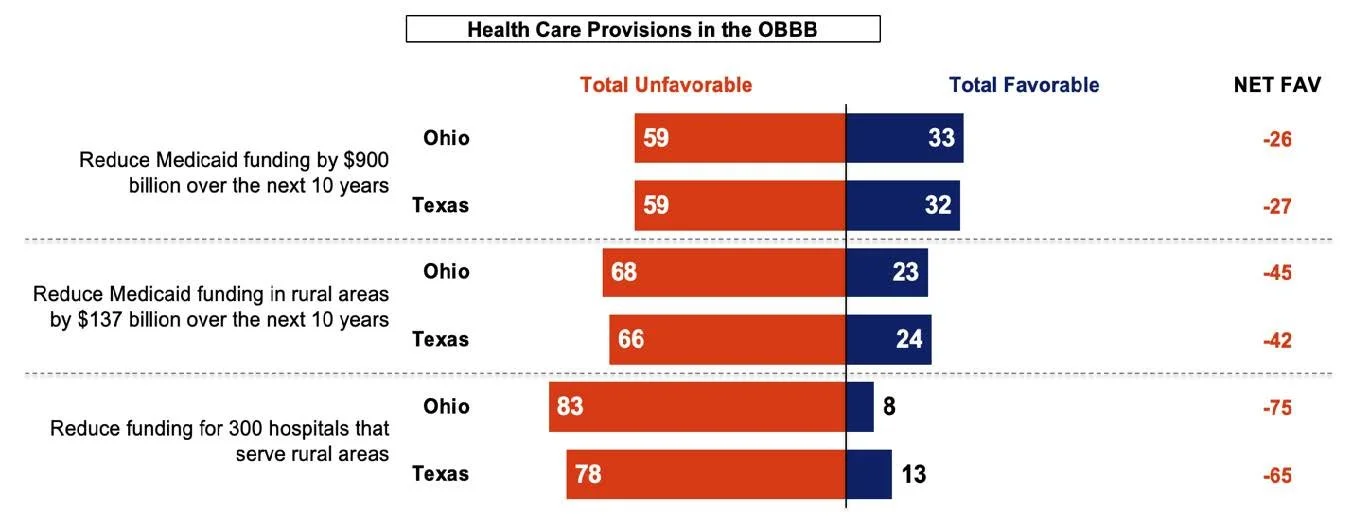
Voters across the partisan spectrum are protective of Medicaid funding, specifically rural funding and hospitals. “Reducing Medicaid funding in rural areas” by $137 billion is opposed by 96% of Ohio Democrats and 89% of Texas Democrats, 76% and 75% of Independents, and 44% of Texas Republicans (a plurality), while Ohio Republicans are split (41% oppose / 43% favor). Further, opposition to reduced funding for hospitals that serve rural areas is nearly universal, including 97% of Ohio Democrats and 90% of Texas Democrats, 85% of Ohio Independents and 87% of Texas Independents, and 73% of Ohio Republicans and 64% of Texas Republicans.
In Texas and Ohio, voters are poised to reward leaders who protect Medicaid and rural hospital funding. In Texas, 78% of voters support the state’s successful lawsuit against the federal government to restore $10 billion in Medicaid funding and nearly three-quarters (74%) support the state’s new arrangement with the federal government to restore $12 billion in at-risk Medicaid funding for hospitals, doctors, and clinics. In Ohio, two-thirds (67%) support the provisions Ohio’s congressional leaders secured last year to stop some of the deepest cuts to Ohio Medicaid, expand the state’s Rural Health Fund, and establish new resources for rural hospitals.
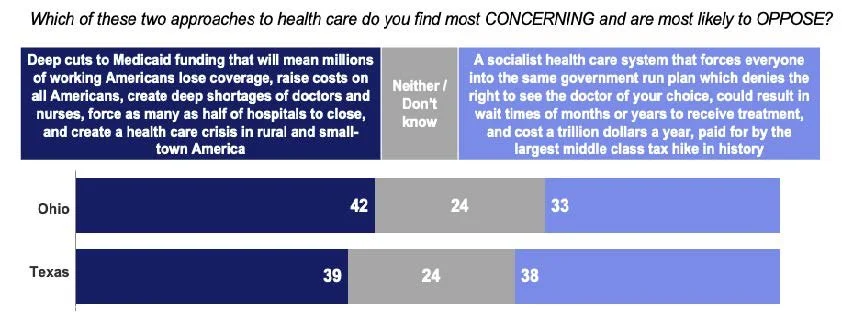
In fact, a forced choice question shows as much or more voter concern with Medicaid cuts as with adopting a “socialist health care system.” In Ohio, voters are more concerned about deep Medicaid cuts (42%) than about a socialist health care approach (33%), by a 9-point margin. In Texas, just as many voters areconcerned about Medicaid cuts (39%) as about the specter of a socialist health care system (38%).
Key Findings
Top-of-the-ticket races in both of these traditionally Red states are incredibly competitive due to Democratic candidate strength with swing Independent voters.
Health care is an intensely important issue and voters are very protective of Medicaid and oppose the Medicaid funding cuts within the OBBB.
While Republicans are on the defensive on rural funding and hospital cuts from the OBBB, individual Republican candidates do have potentially compelling stories about protecting funding. Given that, Democrats should be very aggressive in prosecuting the case against cuts to Medicaid to play offense on an issue that could propel Democratic success and serve as the underpinning of winning majority-making U.S. Senate seats in Ohio and Texas.
